
Rabbi Shaul Yedidya Shochet
שאול ידידיה ב"ר אברהם חיים
Rav, Louisville, KentuckyDate of Death:
Wed. December 23, 1925 -
Teves 6 5686
Anyone with biographical information is asked to please send it in.
See CONTACT page for details. Thank you.
Directions to Kever: NEEDED
Biographical Notes:
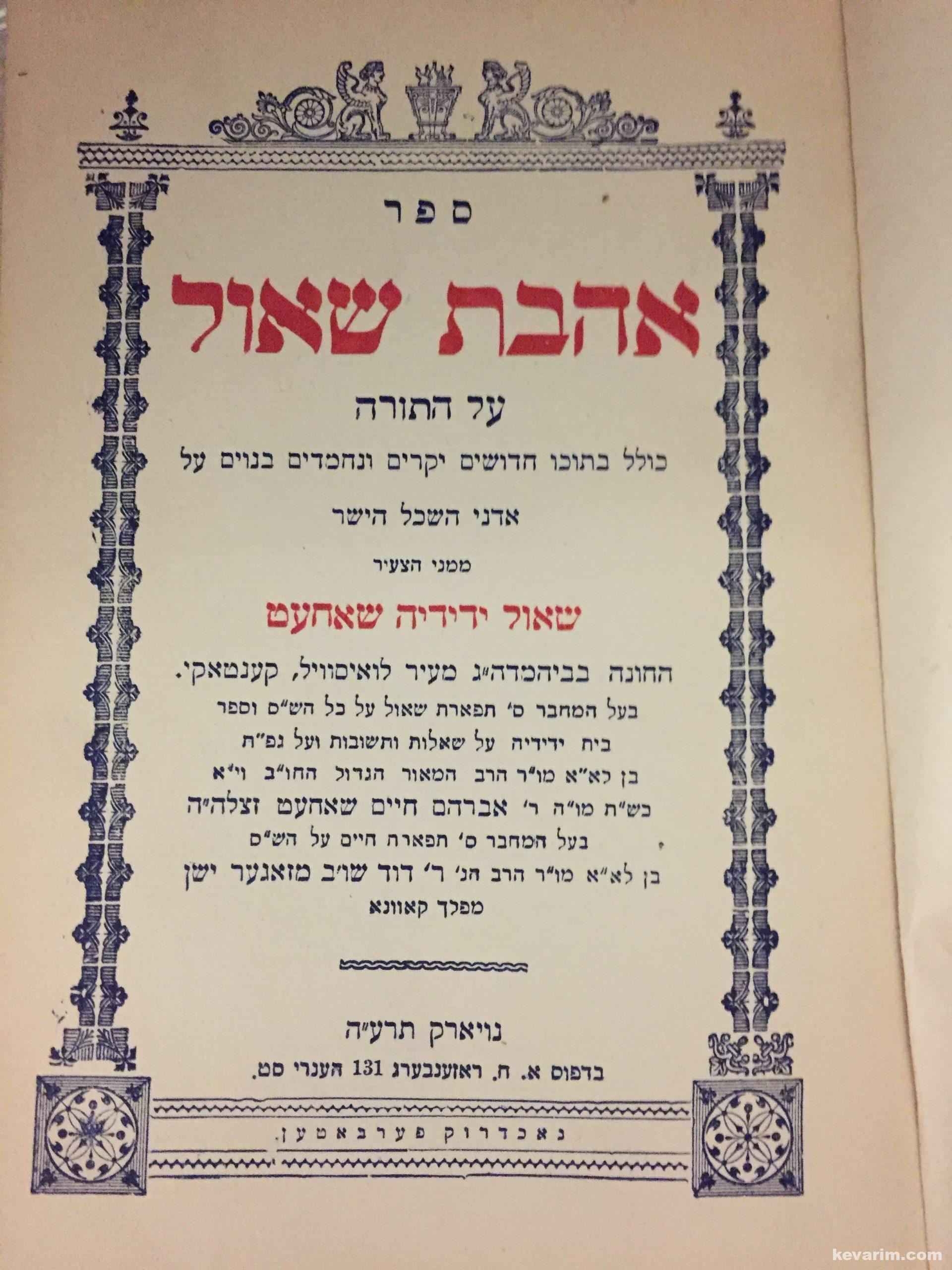
Credit: Institute For Judaic Culture and History (IFJCAH)

Credit: Institute For Judaic Culture and History (IFJCAH)
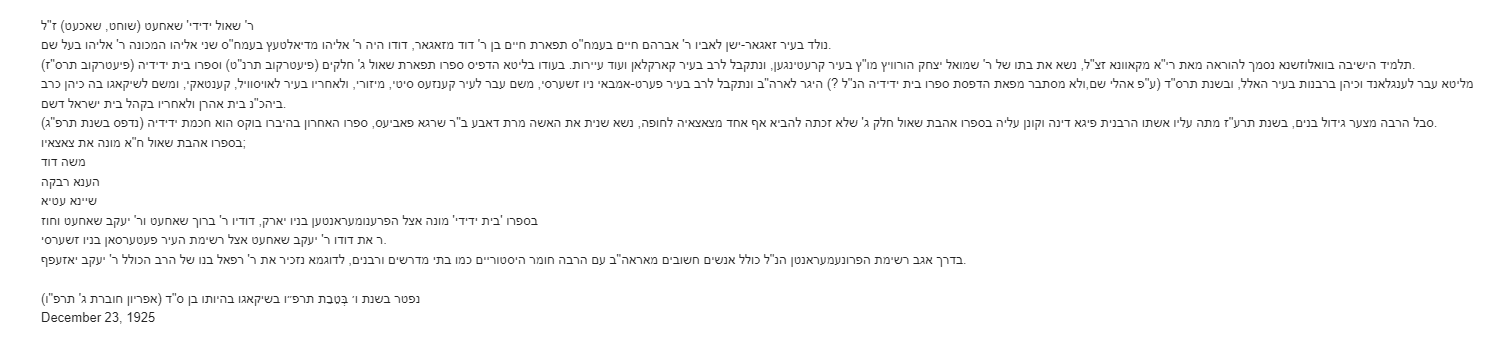
Source: Needed
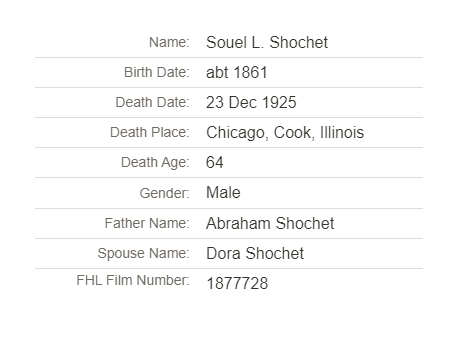
Credit: MCA

Credit: NEEDED
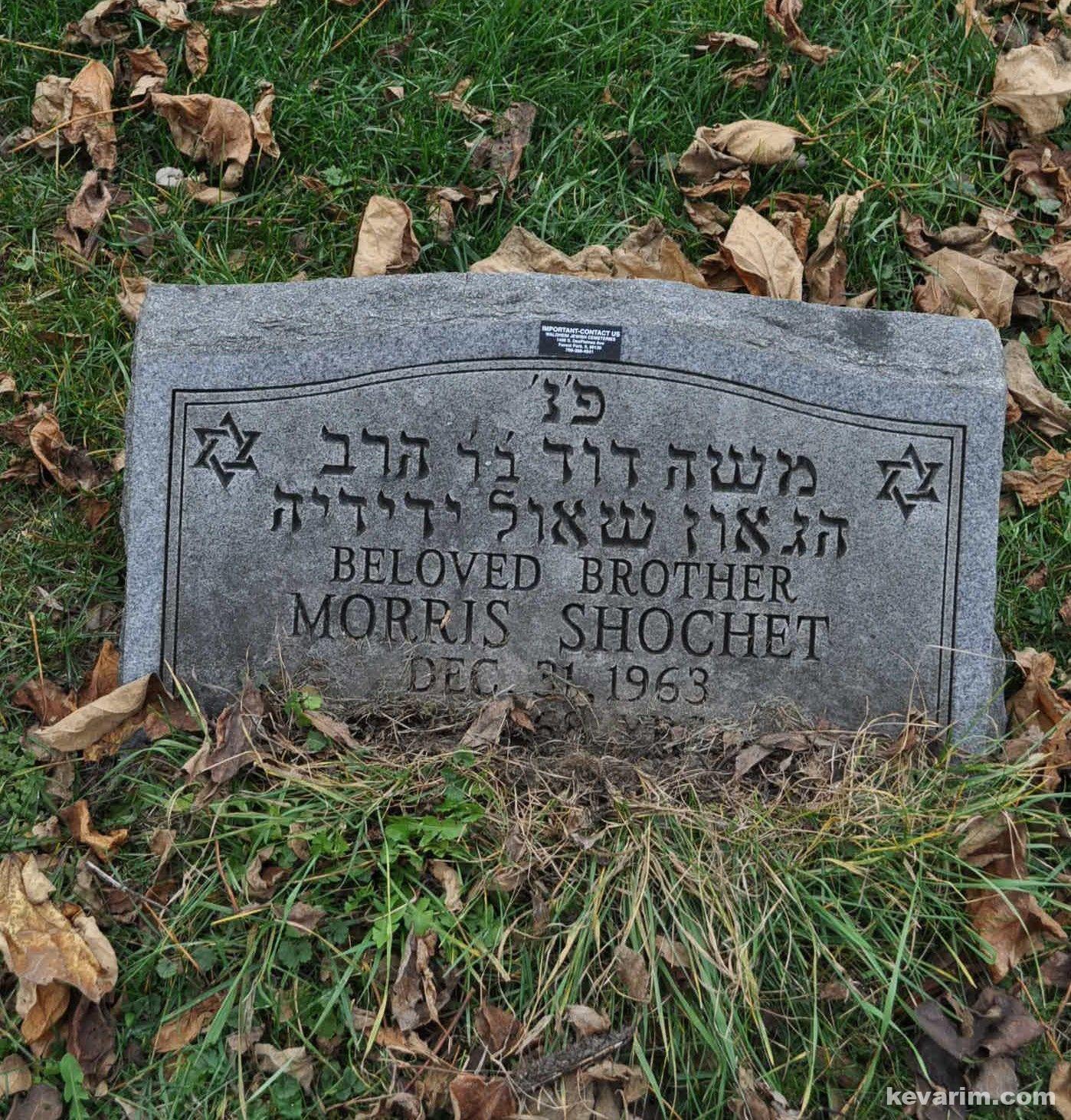
Credit: Moshe Dovid Shochet buried at Waldheim, Credit: formerTexasgravedigger
« Previous: Rabbi Avroham Simcha Bunim IromNext: Rabbi Nachman Pusin »


I’m shocked no one has any info on it
He was one of the Biggest Gedolim of the USA, wrote over 6 Seforim, and all American Gedolim send him Shaalos
His books were donated to the yeshiva in Skokie Il. As far as I know, the books are still there
I am his grandson
I am one of his great granddaughters. His books were donated to the Yeshiva on the west side of Chicago. I have visited his grave with two other of his great granddaughters. My sister may have a few of his books.
Sherwin and Fay can you share the location of his grave?
Also does your family have any pictures of him?
@sherwin ernst and @fay kosnoff, can you please share information on the location of his grave, name of cemetery etc. Also @fay kosnoff, is there a way i can get in touch with your sister please to see if she has any more copies of his seforim i enjoy learning from the ravs seforim.
Would love to know where he is burried he was from the biggest tzadadikim of the history of the USA
I have his Sefer Ahavas Shaul. I would like to know more about him
In 1901, Rav Yehuda Yudel Rosenburg, the holy mekubal of Canada remarked that america was assured to become a source of holiness and torah becuase Rav Shaul dwelled there. When he passed away, Rabeinu Yudel was unconsolable with sadness.
The satmar rav, Rav Yoel Teitlebaum, was given set of photographs of many gedolim, among them his anscestors, and this stack included Rav Shaul. Rav Yoel commanded the man to burn them because of a kabbalistic statement that any picture has an impure spirit. His discourses were sent to Rav Yosef Yitzchak Schneerson of Lubavitch who was impressed by their sincerity.
Does anyone know where he is burried in a few month it’s gonna be a 100 Years from his petirah and it would be nice to go to his kever, its sounds like it in chicago area the only question is where, i heard he was a very big person, and the european rabbanim respected him a lot
Yankiv and Menachem – I do not know where he is buried. I am working on doing a blog post. Look at my website at kotzk.com and hit the tag Rabbi Shaul Yedidya Schochet.
Yankiv – where did you get that information.
What is fascinating is that two of the Haskomos are from Rav Avrohom Yitzchok Hakohen Kook and the Ridvaz. Great Haskomos in their own ways. Rav Kook’s Haskamah was from Rav Kook when he lived in Boisk before he made Aliyah.
Contact me at 773-647-8097
Yankiv and Menachem – I do not know where he is buried. I am working on doing a blog post. Look at my website and click on the tag Rabbi Shaul Yedidya Schochet.
Yankiv – where did you get that information.
What is fascinating is that two of the Haskomos are from Rav Avrohom Yitzchok Hakohen Kook and the Ridvaz. They are both remarkable Haskomos in their own unique ways. Rav Kook’s Haskamah was from when he lived in Boisk before he made Aliyah in 1907..
Yankiv and Menachem – I do not know where he is buried. I am working on doing a blog post. Look at my website and click on the tag Rabbi Shaul Yedidya Schochet.
Yankiv – Where did you get that information?
Yahrzeitis the sixth of Teves.
What is fascinating is that two of the Haskomos are from Rav Avrohom Yitzchok Hakohen Kook and the Ridvaz. They are both remarkable Haskomos in their own unique ways. Rav Kook’s Haskamah was from when he lived in Boisk before he made Aliyah in 1907.
Yankiv and Menachem – I do not know where he is buried. I am working on doing a blog post. Look at my website and click on the tag Rabbi Shaul Yedidya Schochet.
Yankiv – Where did you get that information?
Yahrzeit is the sixth of Teves.
What is fascinating is that two of the Haskomos are from Rav Avrohom Yitzchok Hakohen Kook and the Ridvaz. They are both remarkable Haskomos in their own unique ways. Rav Kook’s Haskamah was from when he lived in Boisk before he made Aliyah in 1907.
Comprehensive biographical information on Rabbi Shaul Yedidya Shochet
Below is a comprehensive overview of Rabbi Shaul Yedidya Shochet’s life, family, rabbinic career, and published works, based primarily on the following primary sources: the “Apiryon” Torah journal, Issue 3 (5686/1926), which published his obituary and biographical sketch shortly after his death; the autobiographical introduction to his own work “Chochmat Yedidya” (St. Louis, 5683/1923), written three years before his death; the title page, introduction, and approbations of “Tiferet Yedidya” (St. Louis, 5680/1920); “Ohalei Shem” by Rabbi Samuel Noah Gottlieb (Pinsk, 1912); and the approbations to “Beit Yedidya” (Piotrkow, 5667/1907) as reprinted in “Tiferet Yedidya.”
BIRTH AND ORIGIN
Rabbi Shaul Yedidya Shochet was born on 21 Av (Menachem Av) 5620, August 17, 1860, in the town of Old Zhager (Alt-Zoger, Zager Yashan; today Zagare, Lithuania), then in the Kovno Governorate of the Russian Empire. He himself states his exact birth date in the introduction to “Chochmat Yedidya”: “Being sixty years and one day old, on the 21st of Menachem Av in the year 5620, I was born in the town of Zager Yashan, in the Kovno Governorate, the land of Russia.”
FAMILY AND LINEAGE
His father was Rabbi Avraham Chaim Shochet, who served as a shochet (ritual slaughterer) and chazzan in Old Zhager, and was also a moreh hora’ah (halakhic decisor) in the town. He authored the work “Tiferet Chaim” on tractates of the Talmud. According to his son’s testimony in “Chochmat Yedidya,” “all the rabbis of his time mentioned his books in their studies.”
His paternal grandfather was Reb David Shochet of Old Zhager, who also served as a shochet in the town.
His father’s uncle (his own great-uncle) was Rabbi Eliyahu of Dialtetz, author of “Shenei Eliyahu” on tractate Avot of Rabbi Natan. This great-uncle was publicly known as “Rabbi Eliyahu Baal Shem” (Rabbi Eliyahu, Master of the Divine Name). Rabbi Shochet describes him as a “divine Kabbalist gaon,” indicating he was regarded as a baal shem engaged in practical Kabbalah.
EDUCATION
Rabbi Shochet studied at the famed Volozhin Yeshiva, known as “the mother of yeshivot,” the central institution of Lithuanian Jewry, founded by Rabbi Chaim of Volozhin, foremost disciple of the Vilna Gaon. Based on his birth year, he likely studied there during approximately 1875 to 1882, when the Netziv (Rabbi Naftali Zvi Yehuda Berlin) served as rosh yeshiva together with his nephew Rabbi Chaim Soloveitchik of Brisk.
In the introduction to “Chochmat Yedidya,” Rabbi Shochet describes his approach to Torah study: “The essence of the study of our holy Torah is through the path of pilpul, as is known, the Blessed One has been with me in the pilpul of Torah to bring understanding.”
ORDINATION
Rabbi Shochet received semicha from Rabbi Yitzchak Elchanan Spektor of Kovno, one of the most important poskim of Lithuanian Jewry of his generation, who served as the central halakhic authority on agunot matters for all of Eastern European Jewry.
FIRST MARRIAGE
Rabbi Shochet married Rebbetzin Figa Dina (Pinya Dina; “Figa” is the Yiddish equivalent of Hebrew “Tzipora,” meaning “bird”). She was the daughter of Rabbi Shmuel Yitzchak Horowitz, who served as moreh tzedek in the town of Kretingen (today Kretinga), Lithuania, and was publicly known by the affectionate epithet “der Kretinger Rebbele” (the little Rebbe of Kretingen). The title “HaKaCh” (Hakohen Tzedek) applied to him indicates priestly Kohanic lineage.
Rabbi Shochet describes his first wife in “Chochmat Yedidya” as “my dear righteous wife, the Rebbetzin Figa Dina, daughter of the holy and righteous Gaon, Rabbi Shmuel Yitzchak Horowitz, of blessed memory, the Kohen Tzedek of Kretingen.”
The couple had three children: Moshe David, Hena Rivka, and Sheina Etya. These names are listed by Rabbi Shochet himself in “Ahavat Shaul” Part I. From his eulogy for his first wife in “Ahavat Shaul” Part III, it appears that none of the children reached the age of marriage during their mother’s lifetime, as he writes that “she did not merit to bring any of her descendants to the chuppah.” It is likely that some of the children died in childhood, a source of grief Rabbi Shochet references in “Chochmat Yedidya” as “the suffering of raising children.”
In 5677 (1917), while Rabbi Shochet was serving as a rabbi in Chicago, Rebbetzin Figa Dina died. He mourned her in “Ahavat Shaul” Part III. About the three years that followed, he writes in “Chochmat Yedidya”: “Three years passed for me in troubles and wanderings, as is known from the saying of the sages: ‘The wanderings of a man are harder than those of a woman'” (citing the Talmudic dictum in Yevamot 118b).
SECOND MARRIAGE
After three years as a widower, Rabbi Shochet remarried. His second wife was Rebbetzin Dobe (Dobbe), a widow, daughter of Reb Shraga Pavies. He describes her as “a woman of valor and fearful of God, Mrs. Dobe daughter of R. Shraga Pavies, who strives with all her strength to assist me.” Dobe had a son from her previous marriage, Shraga Feivel, whom Rabbi Shochet describes as “the distinguished in Torah, the sharp-minded and erudite talmid chacham,” and who studied with him.
RABBINIC CAREER IN LITHUANIA
Rabbi Shochet began his rabbinic career as rabbi of Karklan (Karklenai) in the Kovno Governorate of Lithuania. This is documented in the approbation by Rabbi Shmuel Yaakov Rabinowitz of Yelok to “Beit Yedidya,” dated 13 Iyar 5663 (1903), in which Rabbi Shochet is referred to explicitly as “rabbi of the community of Karklan.” According to “Ohalei Shem,” he also served in additional towns in Lithuania.
While serving in Lithuania, Rabbi Shochet published his first two works in the major Polish-Jewish printing center of Piotrkow: “Tiferet Shaul” in three volumes (5659/1899), novellae on tractates of the Talmud, which was printed twice due to high demand and sold out both times; and “Beit Yedidya” (5667/1907), a book of responsa.
EMIGRATION TO ENGLAND
From Lithuania, Rabbi Shochet moved to England and served as rabbi in the city of Hull, a port city in northeastern England through which many Eastern European Jews passed on their way to America and South Africa. Hull served as an intermediate station for many Lithuanian rabbis on their way to America.
EMIGRATION TO THE UNITED STATES
According to “Ohalei Shem,” Rabbi Shochet immigrated to the United States in 5664 (1904). This date is corroborated by responsa in “Tiferet Yedidya” written in Kansas City from 5665 (1905) onward. He served successively as rabbi of congregations in Perth Amboy, New Jersey; Kansas City, Missouri; and Louisville, Kentucky. This frequent movement between congregations was characteristic of the first generation of immigrant rabbis in America.
RABBINIC CAREER IN CHICAGO
Rabbi Shochet eventually settled in Chicago, where he served at two congregations in sequence. He first served as rabbi of Congregation Beth Aaron (Hebrew: Beit Aharon). His signature on the title page of “Tiferet Yedidya” (1920) reads “Resident of the holy community of Chicago at Congregation Beth Aaron.” His tenure here likely extended from the late 1910s until approximately 5682 (1922).
Around 5682 (1922), he moved to serve as rabbi of Congregation Beth Israel. In the introduction to “Chochmat Yedidya” (1923), he writes: “I extend my blessing to the people of my congregation Beth Israel in the city of Chicago, Illinois, who honor me with respect; may God remember them for good.”
PUBLISHED WORKS
Rabbi Shochet authored exactly six books in Hebrew. In the introduction to “Chochmat Yedidya” he writes explicitly: “When I awaited to bring to light my book Chochmat Yedidya, that is my sixth composition.”
1. Tiferet Shaul (Piotrkow, 1899). Three volumes. Novellae on tractates of the Talmud. Printed twice, with all copies sold.
2. Beit Yedidya (Piotrkow, 1907). A book of responsa. Available on HebrewBooks #2170. The book received three approbations from leading rabbis: Rabbi Yaakov Dovid Wilovsky (the Ridvaz), then rabbi of Slutsk and later of Safed, author of the Commentary of the Ridvaz on the Jerusalem Talmud, in an approbation dated 19 Shevat 5663 (1903), describing Rabbi Shochet as “a great man, truly great in Israel, like one of the renowned rabbis”; Rabbi Abraham Isaac Kook (the Raayah Kook), then rabbi of Boisk (Bauska) in Latvia before his emigration to the Land of Israel in 1904, in an approbation dated Monday of Parashat Yitro 5662 (1902), describing Rabbi Shochet as “the great rabbi, the talmid chakham, who has done valiantly in the war of Torah”; and Rabbi Shmuel Yaakov Rabinowitz of Yelok, author of “HaMazkir al haShas,” in an approbation dated 13 Iyar 5663 (1903), referring to Rabbi Shochet as “rabbi of the community of Karklan.”
3. Birkat Shaul. A commentary on tractate Megillah (page by page) and on tractate Kiddushin. The book is mentioned in the introductions to “Tiferet Yedidya” and “Chochmat Yedidya,” but its exact place and date of publication are unknown.
4. Ahavat Shaul (Chicago, 1916). Three volumes of homilies and Torah commentary on the Five Books of Moses and the festivals of the year. Part III includes a eulogy for his first wife Figa Dina who died in 5677. Part II is available on HebrewBooks #2086. The book was rediscovered in 2019 by Rabbi Avrohom Meir Morgenstern at Anshe Sholom B’nai Israel in Chicago.
5. Tiferet Yedidya (St. Louis, 1920). Two volumes, 378 pages. Responsa on Even HaEzer of the Shulchan Aruch, particularly on the laws of gittin (Jewish divorce documents) and agunot. Printed at Monaster Printing at 1318 Carr Street in St. Louis. The author’s introduction is dated 1 Elul 5680. The opening of the book includes reprints of the three approbations originally given to “Beit Yedidya.”
6. Chochmat Yedidya (St. Louis, 1923). Three volumes, 252 pages. The final work published in his lifetime, three years before his death. Includes responsa on all four parts of the Shulchan Aruch; novellae on tractates of the Talmud (Berakhot, Shabbat, Eruvin, Sukkah, Chagigah, Yevamot, Avodah Zarah, Sanhedrin); and novellae on the Torah from Bereishit through Shemini. The book was published without rabbinic approbations. In his introduction, Rabbi Shochet explains: “Although it is the custom of authors to obtain approbations on their books, in my eyes it is unnecessary. For he who wishes to look at my approbations may look at the book Tiferet Shaul and at my book Beit Yedidya and at my book Tiferet Yedidya, and this would be nothing but pride.” The long autobiographical introduction to this work provides the most detailed source of information about Rabbi Shochet’s family, education, marriages, and intellectual journey.
CORRESPONDENTS
From the contents of his responsa works, Rabbi Shochet maintained an extensive network of halakhic correspondence with contemporary poskim in the United States, including Rabbi Tobias Geffen of Atlanta, Georgia; Rabbi Tzvi Hirsch Grodzinski; Rabbi Yosef Zechariah Rosenfeld of St. Louis; Rabbi Yechiel Michel Leimer of “Agudath HaKehillot” of New York; Rabbi Shimon Marshelitz of Congregations Bnei Ohel Yitzchak and Bnei Yavneh v’Nahal Yitzchak of Chicago; Rabbi Nissan Mordechai of Buffalo; Rabbi Meir Tzvi Hirsch, rabbi of San Francisco; Rabbi Dov Ber Abramowitz of St. Louis; and Rabbi Mordechai Shlomo Zieber of Minneapolis.
CHICAGO RABBIS WHO SUBSCRIBED TO HIS WORKS
The subscriber list at the end of “Tiferet Yedidya” (1920) names approximately twenty rabbis of Chicago of that era, including Rabbi Tzvi Albom (rabbi of Machzikei Mishna v’Gemara), Rabbi Azriel Epstein (Beth HaMidrash HaGadol and Bnei Yaakov), Rabbi Shmuel Shak (Kehillot Yaakov), Rabbi Aryeh Leib Kaplan (Anshei Odessa), Rabbi Ephraim Epstein (Kneseth Israel), Rabbi Moshe Yehuda Fischer (Anshei Hungary), Rabbi Shaul Silber (Anshei Shalom of Ashland), Rabbi Zelig Glick (Anshei Shalom of Douglas Park), Rabbi Avraham Yitzchok Cardon (Shaarei Torah Anshei Maariv), and Rabbi Mordechai Zevin (Lubavitch).
The list also includes family members and connections of Rabbi Shochet: Shaul Hirshberg of Friars Point, Mississippi, described as “flesh and blood” (a relative); R. Eliyahu Shochet of Denver, a relative; and R. Avay Shaai of Baltimore. The list also includes former members of his father-in-law’s community in Kretingen: “our compatriot from Karklan, R. Avraham Gavriel Drei”; “our compatriot R. Moshe Sopher from Kretingen”; “our compatriot R. Chaim Yitzchak Sopher from Kretingen”; R. Shmuel Dov Stalna; and “our compatriot R. Avraham Sopher.”
HALAKHIC METHODOLOGY
Rabbi Shochet’s halakhic methodology reflects the classical Lithuanian yeshiva approach. The title page of “Tiferet Yedidya” describes his responsa as “built on the foundations of common sense reasoning on the four parts of the Shulchan Aruch.” He combined broad bekiut (encyclopedic knowledge) in the Talmud, Rishonim, and Acharonim with pilpul and careful analytic reasoning to arrive at halakhic conclusions.
His main area of halakhic focus was Even HaEzer, particularly the laws of gittin and agunot, which were especially burning in American Orthodoxy of his era, as mass immigration from Eastern Europe left many women in halakhically complex situations. He also wrote on the writing of names in gittin (including a famous responsum on the spelling of the name “Velvele”), chalitzah, yichus and conversions, and holiday halakha.
DEATH
Rabbi Shaul Yedidya Shochet died in Chicago in 5686 (1926) at the age of 64. An obituary and biographical sketch were published in the Hebrew Torah journal “Apiryon” in Issue 3 of that year, which is the primary source for the details of his life and rabbinic career.
LEGACY
Rabbi Shochet was one of the senior and respected rabbis of Chicago of his generation. His responsa, particularly “Tiferet Yedidya,” remain an important historical source for the study of American Jewish life in the early decades of the 20th century, documenting the halakhic challenges faced by immigrant communities, the network of poskim in America, and the relations between American and Land of Israel rabbinates (through Rabbi Kook’s approbation, which was reprinted even after his immigration to the Holy Land). His subscriber lists and responsa correspondents collectively form a valuable map of Orthodox American rabbinic life in the early 20th century.
KEY DATES SUMMARY
Born: 21 Av 5620 (August 17, 1860), Old Zhager (Zagare), Lithuania
Studied at: Volozhin Yeshiva
Ordained by: Rabbi Yitzchak Elchanan Spektor of Kovno
First wife (Figa Dina): married c. 1880s; died 5677 (1917)
Three children: Moshe David, Hena Rivka, Sheina Etya
Began rabbinic career: Karklan, Lithuania (by 1903)
Emigrated to England: Rabbi of Hull
Emigrated to America: 5664 (1904)
American congregations: Perth Amboy, then Kansas City, then Louisville, then Chicago (Beth Aaron, then Beth Israel)
Six books: Tiferet Shaul (1899), Beit Yedidya (1907), Birkat Shaul, Ahavat Shaul (1916), Tiferet Yedidya (1920), Chochmat Yedidya (1923)
Second wife (Dobe): married c. 1920
Died: 5686 (1926), Chicago, age 64
Obituary published in: Apiryon, Issue 3, 5686 (1926)
If anyone has additional information, particularly photographs, descendants’ family histories, exact burial location at Waldheim Jewish Cemeteries in Forest Park, or copies of the books “Tiferet Shaul” (1899), “Birkat Shaul,” or “Ahavat Shaul” Part I or III, please share. Such information would be valuable for completing the historical record of this important American Orthodox rabbi.
This is the exact location of the grave
41.862361,-87.820972