
Rabbi Chaim Yaakov Widerwitz
חיים יעקב ב"ר בנימין
Chief Rabbi of AmericaDate of Death:
Wed. May 10, 1911 -
Iyyar 12 5671
Anyone with biographical information is asked to please send it in.
See CONTACT page for details. Thank you.
Directions to Kever: Although in a constant state of cleanup, Bayside Cemetery along Pitkin Avenue in Queens is in extreme disarray and can be dangerous, use caution when visiting!!! In the event of an emergency call 911. Location: Society: Congregation Lubowitz Weinzein, Path: A, Gate: 13, on the right side a few graves in. The second section from the Liberty Avenue entrance)
Biographical Notes:
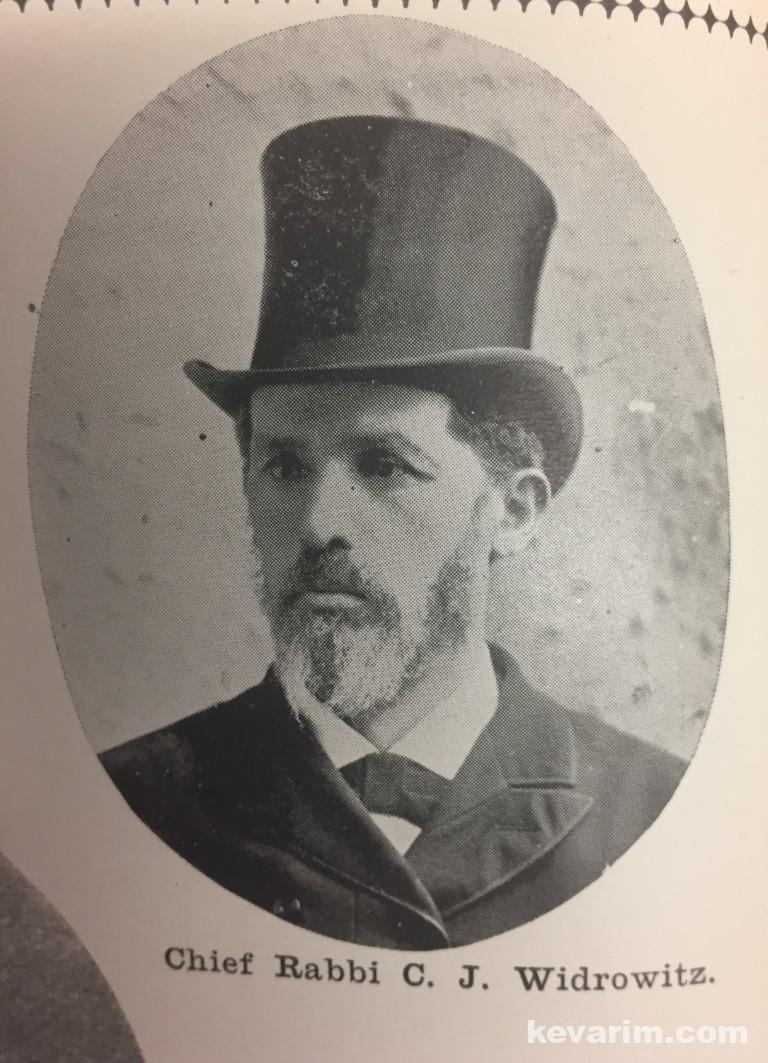
Photo Caption: Rabbi Chaim Yaakov Widerwitz, Credit: IFJCAH
Bio Information:
Rav Wderwitz, prior to his arrival in the United States was the Chief Rabbi of Moscow. The story goes that the Rav was once asked who made him Chief Rabbi of America to which he replied the sign painter.
« Previous: Rabbi Avigdor RegenbogenNext: Rabbi Dr. Chaim (Henry) Pereira Mendez »


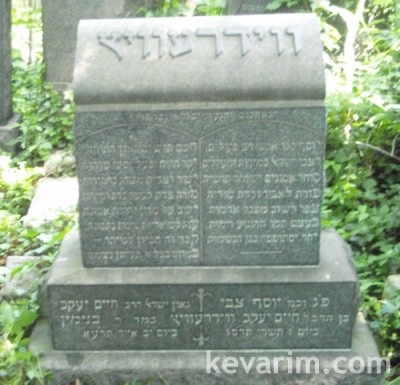
I was there, many years ago, I believe you have it right. He is buried alongside his son.
Just a little tip for anyone visiting the Bayside Cemetery, it?s in a rough neighborhood, so either go with someone or in the morning.
I tried getting there, but the cemetery is such a mess!!!!!!!!
Is there a way of arousing interest in the community to get the cemetery cleaned up??????
WOW, the place is a jungle, how did you find it?
Based on the Matzieve, you should change the name to ‘Chaim Yaakov’.
The Rav was closeley affiliated with Lubavitch, he worked on the ‘Shu”t Zemach Zadik’ and is likeley that he served as rav in one of the two Lubavitcher Shuls in his area on Henrey St.
His wife Pesa was one of the founders of the Laidies Auxilary of Lubavitch.
(Toldos Chabad, Levin)
According to the NY Times report, Lower east Side has not seen a large funeral like the one of Rabbi Widerwitz since the death of Cheif Rabbi Joseph.
The Rav was 75 years old at the age of his death, it is noted that he was a leading arbiter in family disputes in the East-Side.
http://query.nytimes.com/mem/archive-free/pdf?res=9F02E4D81439E333A25752C1A9639C946096D6CF
interesting, according to the NYT report there were over 5,000 people there, can that be compared to the 100, 000 at R’ YY’s levayah?!
in 1892 he is klisted as the Rav of Bies Hamedresh Anshie Lubavitch V’Niezin on 48 Ludlow St. in NY, see link
http://books.google.com/books?id=p5lAAAAAYAAJ&pg=RA1-PA132#v=onepage&q=&f=false
He’s buried in gate 13, currently however it’s easier to access him by entering gate 14, after a couple plots, approx 10 stones you’ll be able to see his headstone to your left. Did anyone come across a pic of him?
I have one, it’s on the list for posting.
R’ Barhuch we are waiting for the pic.
http://www.archive.org/stream/spiritofghettost00hapg#page/68/mode/2up
In the last year of his life, R’ Widrewitz arbritrated a dispute over the kashrus of the Mikvah in Seattle, WA. The rov of the Seattle kehilla, R’ Gedalyah Halperin, allowed the mikvah to be filled by municipal city water, while another prominent posek from St. Louis, R’ Zecharia Yosef Rosenfeld, held that it was pasul. R’ Halperin sent both his teshuva and that of R’ Rosenfeld to R’ Widrewitz asking for an opinion, and he wrote back a letter supporting the position of R’ Halperin. All these letters are printed in R’ Halperin’s Sefer Mei Gava found here –
http://www.hebrewbooks.org/10040 (p50)
It’s interesting that in his letter, R’ Widrewitz alludes to the fact that he had been ill for a while, and I wonder given the timing, whether this illness was ultimately the cause of his petira.
Along with him is buried his son R’ Yosef Tzvi who past away a few years before him on 7 Tishrei 5667-1906, there’s an interesting article in the newspaper i’m linking where he’s praised for leaving in his will some extra money that his wife should remarry after he dies.
http://fultonhistory.com/Newspaper4/Binghamton%20NY%20Press%20Grayscale/Binghamton%20NY%20Press%20Grayscale%201906.pdf/Binghamton%20NY%20Press%20Grayscale%201906%20-%200481.pdf
http://chroniclingamerica.loc.gov/lccn/sn83030193/1906-10-23/ed-1/seq-12.pdf
NYT on his Rebbetzins passing
http://query.nytimes.com/mem/archive-free/pdf?res=FB0B16FF345D12738DDDA90B94DA415B818CF1D3
According to the incorporation papers, my great-grandfather, David Albert, was one of the founders of Lubowitz Weinzein, and his son, a lawyer, Abraham Albert, drew up the legal documents. I’d appreciate any more information about this landsmanshaft.
Pix of Rebbetzin Tamra Widrevitz’s Marker
http://s949.photobucket.com/user/aman51/media/Bayside/TamraWidrevitz_zpsa24d651b.jpg.html
Pix of Pesha Widrevik’s Marker:
Front:
http://s949.photobucket.com/user/aman51/media/Bayside/PeshaWidrevik_zps8ac7edf5.jpg.html
Back:
http://s949.photobucket.com/user/aman51/media/Bayside/PeshaWidrevikBack_zpsc90f44e8.jpg.html
I believe he was Rav of Nezhiner Shul in Philadelphia. Can anyone confirm? Also, I believe the name is “Widrewitz” and not “Widerwitz.”
Was he a talmid of the Tzemach Tzedek, who sent a message that in America, אוכלים בשר ממש? Was he a בר פלוגתא of the Rav Yaakov Yosef?
according to the ami magazine Rav chaim yaakov widrewitz was a fiery Lubavitcher chassid of the rebbe maharash who sent him to be the Rav of the lubavitch kehila in Moscow where he was also recognised by the non chassidim and later was known as the “Moscover Rav” he remained in Moscow for 16 years until 1891 when thousands of jews were expelled from the imperial city without warning. so together with thousands of Russian jews he and his grandson -shaul widrewitz- imagrated to America they arrived in may of 1892 they eventually settled on the lower east side on 222 Henry street and then in January of 1893 he was joined by his family. Rav chaim yaakov would go on to be appointed as the formal Rav of anshei lubavitch v’niezhin located at 169 Henry street, “the shul had emerged from the merger of two earlier congregations, anshei lubavitch, and anshei niezhin, named for two of the chabad chasidic courts that emerged from the sons of the tzemach tzedek it came to be known simply as the Lubavitcher shul”.